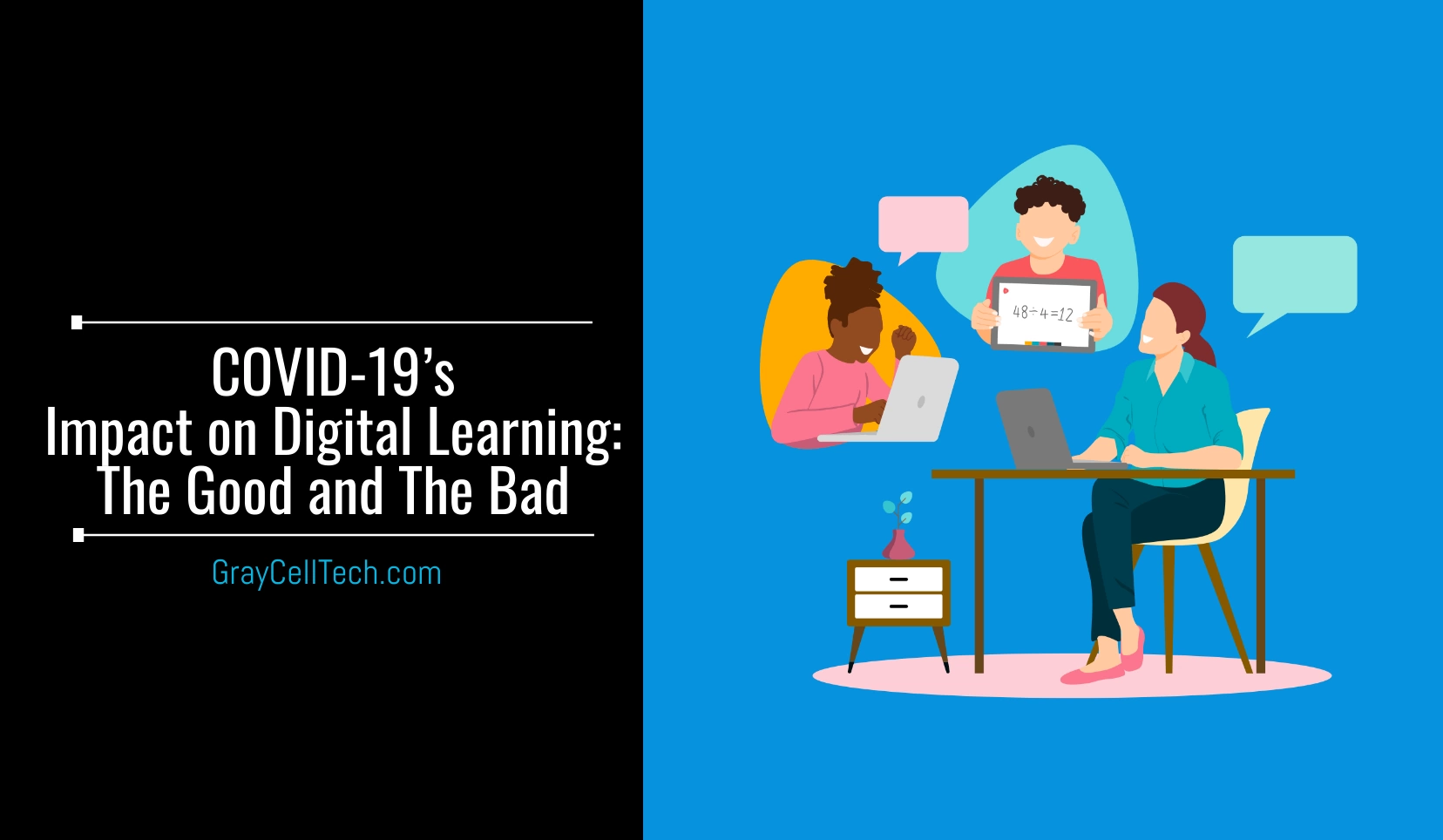
In the mid-week of March 2020, the Indian government took a few precautionary measures (like closing schools and colleges temporarily) to curb the spread of the novel Coronavirus. It is more than two months now and still, there is time for schools and colleges to reopen. Due to lockdown, everything from nursery school admissions, board examinations to entrance tests of different universities and competitive examinations, has been delayed. The lack of a solution to stop the outbreak of COVID-19 has affected the continuity of learning for millions of young learners in India.
The Good
Having said that, the lockdown period is a great time to realize the potential of online learning. Several ed-tech companies have endeavored to leverage the occasion by offering attractive discounts on online courses or free online classes. Students have also shown great interest in e-learning courses, which is why they are currently in trend. Because of its advantages, remote learning seemed to be a viable solution to students during the lockdown period.

With the help of remote learning, a student can easily access any e-learning course at an affordable price at his convenience. Also, e-learning is an interesting and interactive alternative for classroom teaching.
The Bad
Although e-learning is a better alternative than classroom teaching, it is only for the short-term. While classroom teaching requires face-to-face interaction that is considered the best form of communication, remote learning is still impersonalized in nature. Also, students are more likely to get distracted due to several factors such as social media, gaming consoles, and a lack of studying atmosphere, so they often tend to drop out.

Online education is successfully promoted globally, but in India, digital learning has miles to go to enter mainstream education. It is because remote learning mainly relies on a reliable power supply and ubiquitous Internet connectivity, and both these things are far-fetched for tier-2 and tier-3 cities. Online learning has no substitute for field trips, social and cultural attractions of vibrant campus life, and academic exchanges. Therefore, it is crucial to customize remote learning and make it more interactive and personalized.
Overcome The Bad
COVID-19 pandemic has challenged experts to rethink the traditional method of education. Hence, they came up with a viable solution named “digital learning” that can fill the void for classroom education for at least three to four months. Through online learning, the risk of students getting infected from the Coronavirus can be minimized until the classes resume. Moreover, experts have brought limelight to issues related to digital learning.
In the future, digital learning will become a part of mainstream education. Remote learning will enable inclusive education by facilitating learning across diverse geographies in India. It will provide opportunities for educators to come up with the custom-made learning solutions for every student. In the coming years, ed-tech companies will also gain profits by creating vernacular modules. At present, we can say that global Coronavirus has become a turning point for the ed-tech industry.